
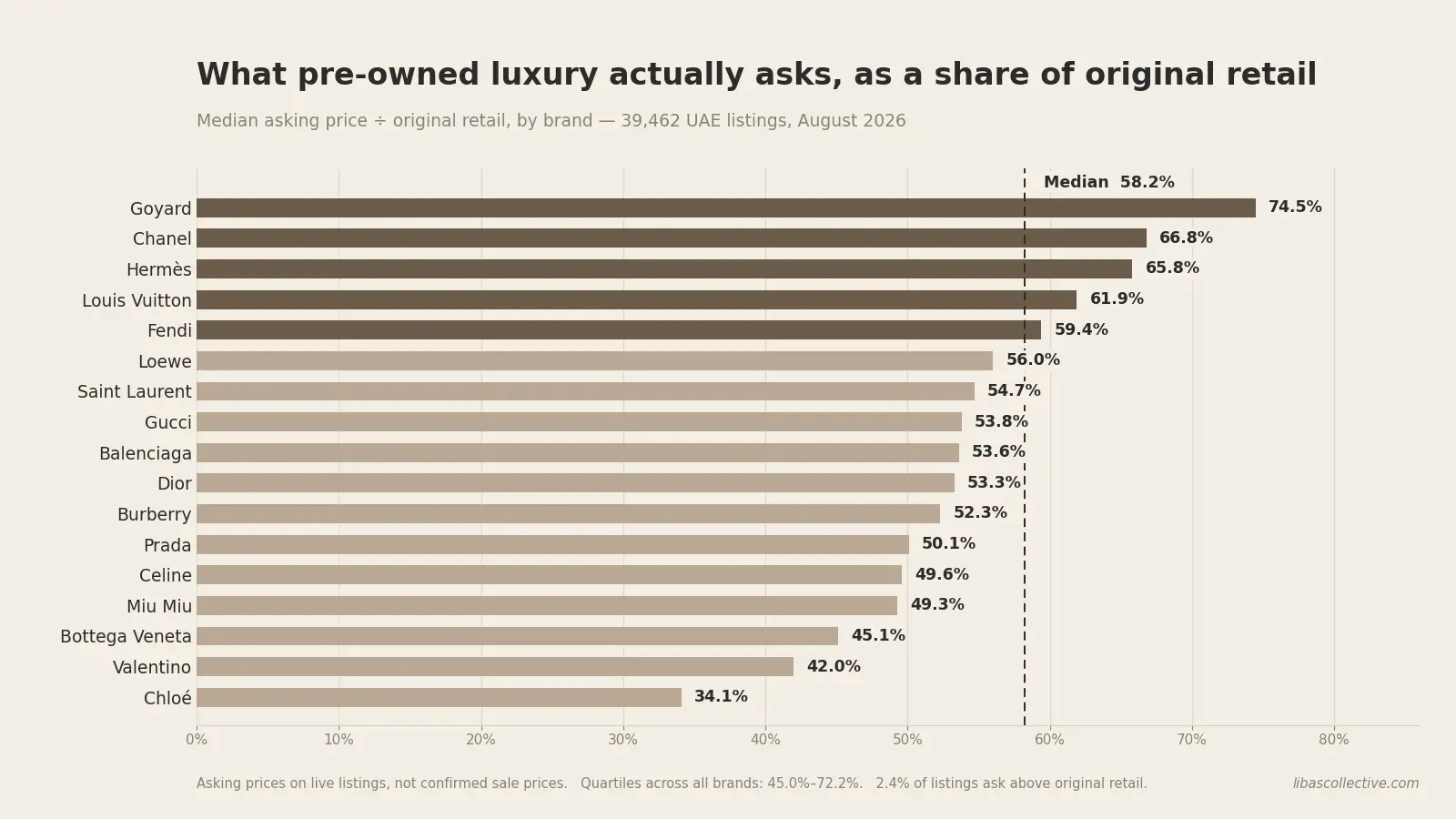
Quick answer: Across 39,462 pre-owned listings in the UAE where we hold both the asking price and the original retail price, the median ask is 58.2% of retail. Goyard, Chanel and Hermès hold most (65–75%). Chloé, Valentino and Bottega Veneta hold least (34–45%). The gap between them is the single biggest factor in what a bag costs you to own.
The headline number: 58.2%
Ask most people what a designer bag is "worth" second-hand and you get a shrug and a guess. We can do better than a guess, because we can measure it directly.
Our catalogue records the original retail price alongside the current asking price on a large subset of listings. As of August 2026 that subset is 39,462 listings — about 36% of the full catalogue of 110,653 items. Comparing the two, item by item:
- Median asking price: 58.2% of original retail
- Lower quartile: 45.0% — a quarter of listings ask less than this
- Upper quartile: 72.2% — a quarter ask more
- 2.4% of listings ask above original retail — the genuinely appreciating tail
So the typical pre-owned designer bag in this market asks a little under 60 cents on the retail dirham. That is the number to hold in your head. Everything interesting is in how far individual brands sit from it.
Brand by brand
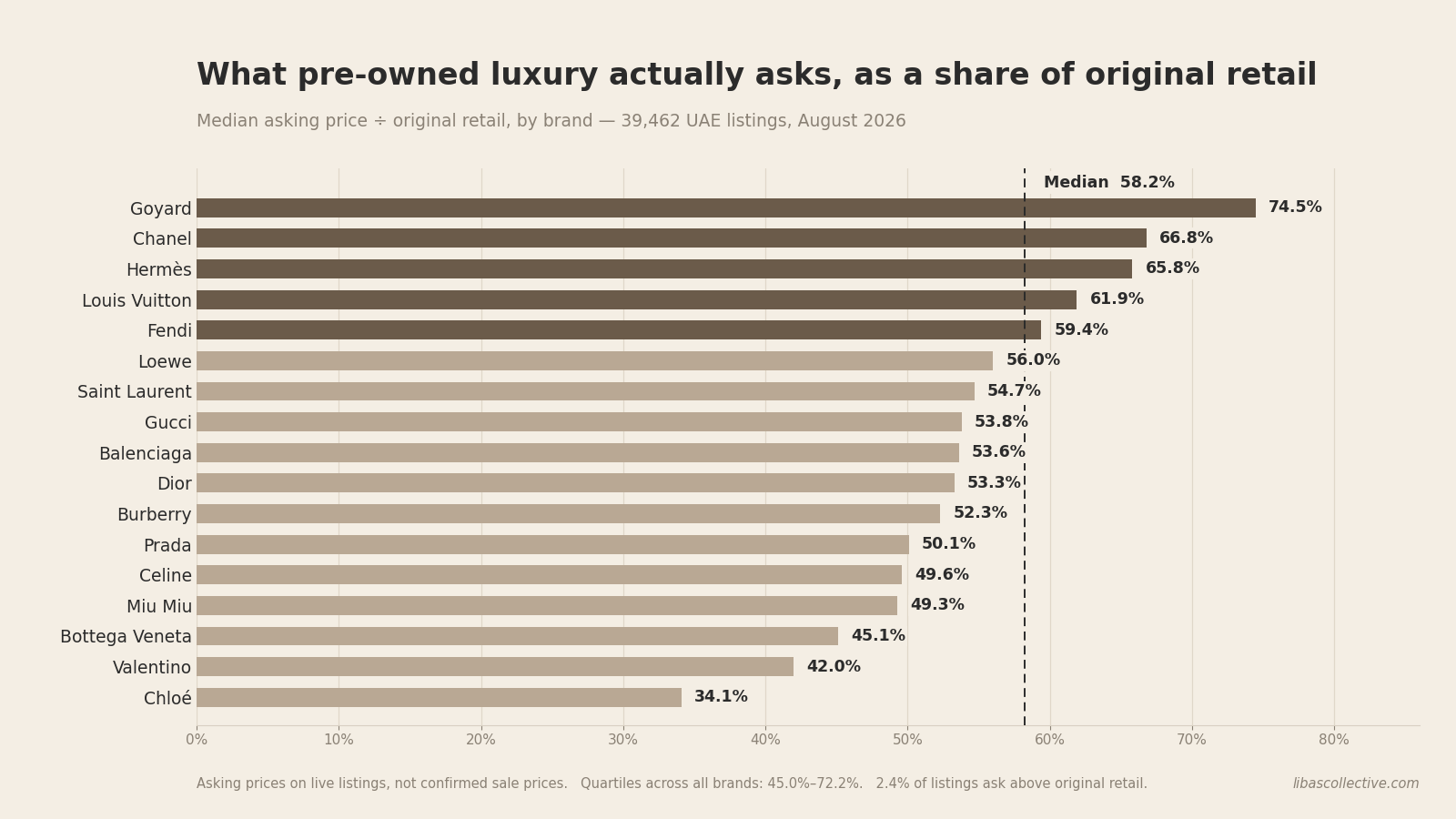
The spread is wide — 40 percentage points between the top and the bottom of the table. That is not noise. It is the most reliable structural fact in this market.
| Brand | Median ask as % of retail |
|---|---|
| Goyard | 74.5% |
| Chanel | 66.8% |
| Hermès | 65.8% |
| Louis Vuitton | 61.9% |
| Fendi | 59.4% |
| Loewe | 56.0% |
| Saint Laurent | 54.7% |
| Gucci | 53.8% |
| Balenciaga | 53.6% |
| Dior | 53.3% |
| Burberry | 52.3% |
| Prada | 50.1% |
| Celine | 49.6% |
| Miu Miu | 49.3% |
| Bottega Veneta | 45.1% |
| Valentino | 42.0% |
| Chloé | 34.1% |
Read that as a cost-of-ownership table rather than a prestige ranking. A Chloé bag is not a worse object than a Goyard one. But if you buy both at retail and part with them three years later, the Chloé has cost you roughly twice as much per year of use.
Why the spread exists
Three things separate the top of the table from the bottom, and none of them is marketing spend.
Supply discipline. The brands at the top control how many units reach the market and refuse to discount. Hermès and Goyard both operate with genuine scarcity and no outlet channel. When the primary market never marks down, the secondary market has no reason to either. Brands that run seasonal sales teach buyers that the retail price is a suggestion, and the resale price follows that lesson down.
Continuity of the icon. A model that has been in the line for decades — the Chanel Classic Flap, the Hermès Kelly, the Goyard Saint Louis — has a stable reference price that everyone in the market recognises. A bag that was the shape of one particular season has no such anchor, and buyers discount it heavily once the season passes.
Retail price increases. This is the quiet mechanism behind the appreciating 2.4%. When a brand raises retail prices repeatedly, the second-hand price of existing stock is pulled up behind it. A bag bought at the old price can be listed today at a number that looks like appreciation but is really the retail line moving underneath it.
What this means if you are buying
The practical use of this table is not "buy Goyard". It is that the discount you are offered and the value you will retain are two different questions, and they pull in opposite directions.
Buying at the bottom of the table gets you the biggest discount off retail — a Chloé bag at 34% of its original price is a genuine bargain in absolute terms. Buying at the top gets you the smallest discount but the best chance of recovering most of what you paid when you move it on. Neither is wrong. They are different purchases: one is consumption, the other is closer to a transfer of value that costs you a use fee.
What is clearly a mistake is paying near-retail for a bag that sits at the bottom of the table. That is the worst of both — full price on the way in, steep discount on the way out.
What this means if you are selling
Price against the brand's actual band, not against what you paid. Sellers routinely anchor to their purchase price and list well above the market, then wait months. The table above is the market's opinion, expressed across tens of thousands of listings — a Prada bag listed at 70% of retail is competing against a distribution centred near 50%.
If you want a fuller picture of where a specific brand sits right now, our UAE pre-owned luxury price index tracks live prices and stock across the whole catalogue, and each brand page — Hermès, Chanel, Goyard — carries live counts and current price ranges.
The sustainability angle, which is mostly an economics angle
Resale is routinely framed as an environmental choice. The data suggests the causation runs the other way: circularity happens reliably where the economics already work, and struggles where they do not.
Almost nobody buys a second-hand bag primarily to keep it out of landfill. They buy it because it is roughly 40% off something they already wanted and it does not feel like a compromise. That discount is the engine. Where resale value holds, the loop is self-sustaining — owners resell because it is rational, and the item keeps moving through hands instead of sitting in a wardrobe.
Where value does not hold, the "sustainable" option needs someone to care on principle, which is a far weaker and less reliable force. The concentration in the market reflects this: of 478 brands with live stock, the ten largest account for roughly 74% of everything listed. Circularity is not evenly distributed. It clusters where value clusters.
That is not an argument against sustainability. It is an argument that the most effective sustainable choice available to a buyer is a boring one: buy the thing that holds value, and you have bought the thing that will actually get re-circulated rather than discarded.
How we measured this
Every figure above comes from our own live catalogue, not from a survey or an industry estimate.
We compare the buyer-facing asking price (including the buyer service fee, so it reflects what a buyer actually pays) against the original retail price recorded on the listing. Prices are held in the listing's own currency and converted to a common basis before comparison.
Two limits are worth stating plainly, because they change how you should read the numbers. These are asking prices on live listings, not confirmed sale prices — the market's offer, not its settlement. And the comparison only exists on the 36% of the catalogue where an original retail price was recorded, which skews toward authenticated supply rather than individual sellers. Both mean the figures describe what pre-owned luxury asks in this market, which is a real and useful thing to know, but is not the same as what it fetches.
Figures are current as of August 2026 and move as stock turns over.
Frequently asked questions
Do designer bags hold their value?
On average they retain a majority of it. The median pre-owned listing in our catalogue asks 58.2% of the original retail price. But the average conceals a 40-point spread: Goyard asks a median 74.5% of retail while Chloé asks 34.1%. Whether a bag "holds value" depends far more on which brand it is than on the category as a whole.
Which designer bag holds its value best?
Of the brands with meaningful volume in our catalogue, Goyard holds most at a median 74.5% of original retail, followed by Chanel at 66.8% and Hermès at 65.8%. All three share the same underlying traits: tightly controlled supply, no discounting in the primary market, and long-running models with stable reference prices.
Do any designer bags increase in value?
Some do. 2.4% of the listings we measured ask more than the item's original retail price. This concentrates in scarce, long-discontinued or hard-to-source pieces, and is often driven as much by the brand raising its own retail prices over time as by the individual bag appreciating.
How much should I expect to pay for a pre-owned designer bag?
Expect to pay somewhere between 45% and 72% of the original retail price — that is the middle half of the market. Below 45% you are usually looking at a brand with weaker resale value, a seasonal model, or heavier wear. Above 72% you are typically in Hermès, Chanel or Goyard territory, or looking at a rare piece.
Why do some brands lose value faster than others?
Mostly discounting and seasonality. Brands that run sales in their own stores signal that the retail price is negotiable, and the second-hand market prices accordingly. Brands built around a handful of continuous icons hold their reference price far better than brands whose line turns over each season.
Is buying pre-owned actually better for the environment?
Extending the life of an existing item avoids the impact of manufacturing a new one, so yes in principle. In practice the effect depends on resale value: items that hold value get re-circulated repeatedly because reselling them is rational, while items that do not tend to stay in wardrobes or get discarded regardless. The environmental benefit follows the economics.
Are these prices what bags actually sell for?
No — these are asking prices on live listings. They represent what the market is offering, which is the leading indicator, but a specific item may settle below its ask. We publish asking prices because they can be measured completely and consistently across the whole catalogue.
Does this apply outside the UAE?
The brand ordering — Goyard, Chanel and Hermès at the top, seasonal fashion brands at the bottom — is consistent with resale markets globally, because it is driven by brand supply policy rather than local conditions. The absolute percentages are specific to the UAE market and to August 2026.