
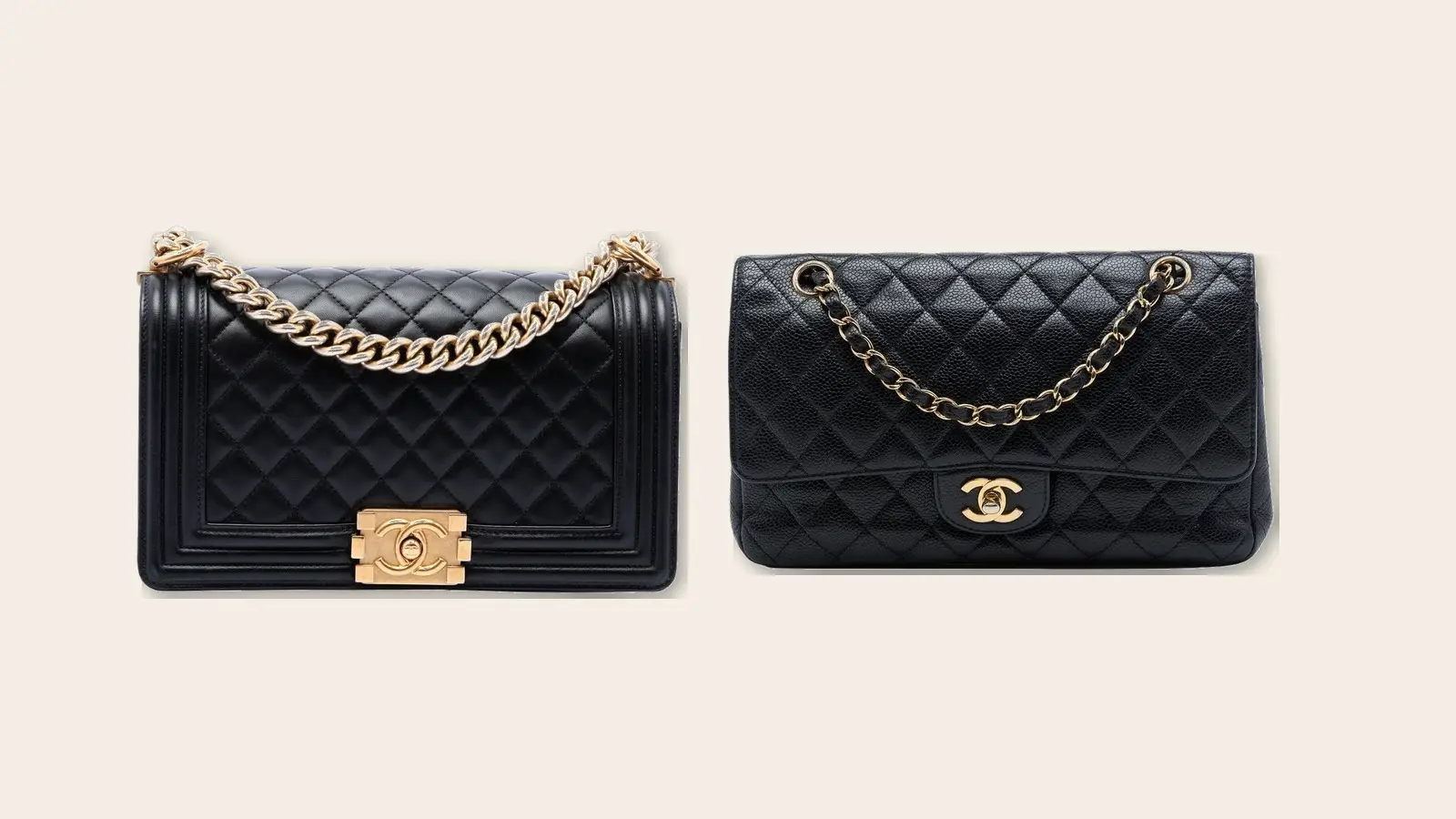
Quick answer: A pre-owned Chanel Classic Flap costs about twice a Chanel Boy — median asking prices of AED 21,675 versus AED 11,028 across our live stock — yet both hold almost exactly the same share of their original retail (58.9% versus 58.0%). The Boy is not the weaker investment. It is the smaller ticket. What actually separates strong value retention from weak is the leather: caviar Classic Flaps ask 64.5% of retail, lambskin 54.6%.
The two bags, in one paragraph each
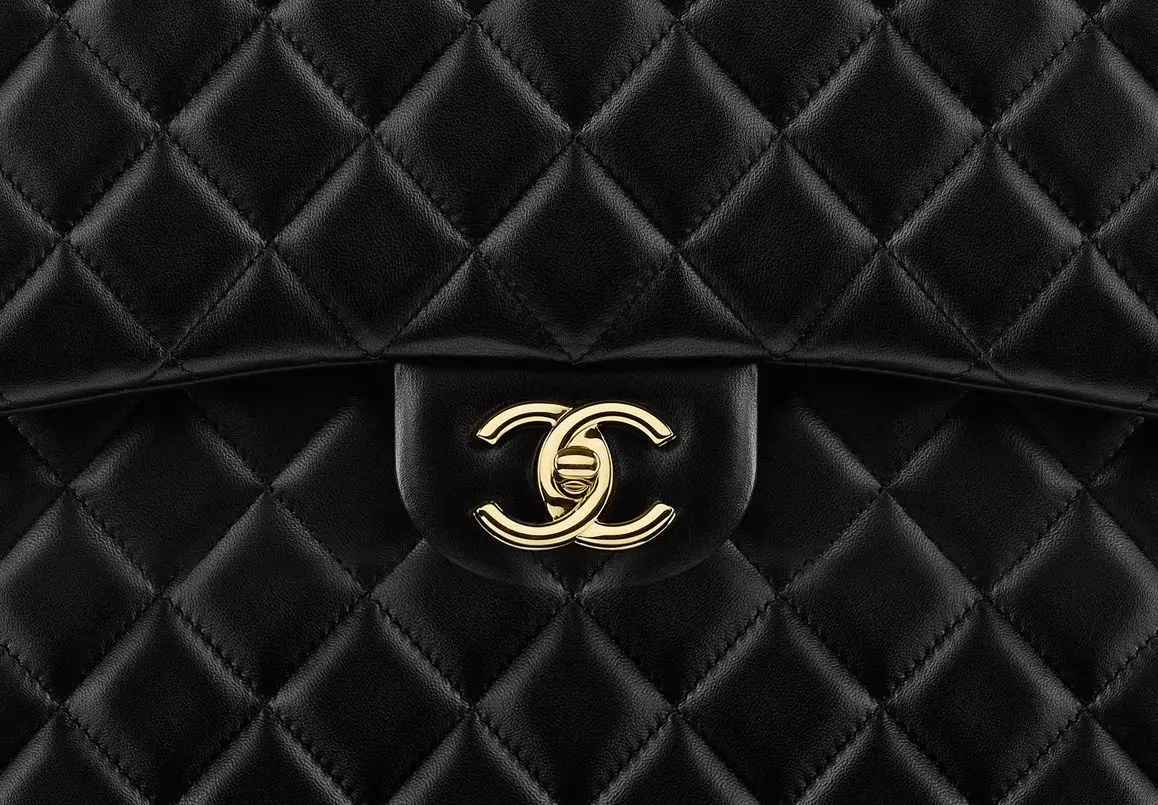
The Classic Flap is Karl Lagerfeld's 1983 redesign of Coco Chanel's 1955 shoulder bag. He kept the quilted body and the chain, wove leather through the links, and swapped the plain rectangular Mademoiselle turn-lock for the interlocking CC clasp. That clasp is the reason most people can identify the bag from across a room, and it is also the reason the 2.55 and the Classic Flap are two different bags rather than two names for one.
The Boy arrived in 2011, unveiled by Lagerfeld for the Cruise 2011/12 season. It was named after Arthur "Boy" Capel — Coco Chanel's great love — and was deliberately built to be the least feminine bag in the house: a boxy, structured rectangle with a wide push-lock plaque and a heavy chain, borrowing its silhouette from a hunting cartridge bag. It is the most commercially successful new Chanel handbag of the last two decades.
Fifteen years later, both are permanent. Both are quilted, chain-strapped, flap-closing black leather bags that cost five figures in dirhams. And buyers ask us to compare them constantly. So we did it with numbers instead of adjectives.
How we measured this
Every figure below comes from Libas Collective's live catalogue on 24 August 2026, not from a survey or a price list. We hold 4,639 authenticated Chanel pieces in stock, of which 2,591 are handbags. Of those we isolated:
- 249 Classic Flaps — items whose model name contains both "Classic" and "Double Flap", so Reissue 2.55s, 19 Flaps and Boy Flaps are excluded.
- 91 Boy flap bags — excluding Boy Wallets on Chain and Boy camera bags, which are a different category of purchase.
Prices quoted are buyer-facing AED — what a UAE buyer actually pays at checkout, service fee included, before VAT. Where we quote value retention, it is the item's current asking price divided by the original retail price recorded for that specific listing, converted to dirhams at that listing's own rate. That is a measure of asking price against retail, not of a completed resale, and it is the honest way to read it.
Finding 1: these are not two points on a spectrum. They are two tiers.
| Chanel Boy (flap) | Chanel Classic Flap | |
|---|---|---|
| Live pieces in stock | 91 | 249 |
| Lowest asking price | AED 7,114 | AED 9,571 |
| Median asking price | AED 11,028 | AED 21,675 |
| Highest asking price | AED 23,948 | AED 36,264 |
| Median original retail (as recorded) | AED 20,562 | AED 38,566 |
| Median asking price as % of retail | 58.0% | 58.9% |
The median Classic Flap costs 1.97× the median Boy. That number is close enough to a clean double that it is worth stating plainly: in the UAE pre-owned market right now, one Classic Flap is two Boys.
More striking is how little the two ranges overlap. Of 249 Classic Flaps in stock, only three are priced below the median Boy. Of 91 Boys, exactly one is priced above the median Classic Flap. These are not two clouds of prices that blur into each other — they are two separate shelves, and a shopper with a fixed budget is almost always choosing between them rather than across them.
Practically, that means the budget makes the decision more often than taste does. Around AED 11,000 you are looking at Boys. Around AED 22,000 you are looking at Classic Flaps. The interesting question is what you get for the extra AED 11,000 — and whether it holds.
Finding 2: the Boy holds its value just as well. This surprised us.
The received wisdom in resale is that the Classic Flap is the safe store of value and everything else is fashion. Our stock does not support that.
Median asking price as a share of recorded original retail:
- Chanel Classic Flap — 58.9% (n = 243; middle half of the range 51.4%–67.6%)
- Chanel Boy — 58.0% (n = 84; middle half 48.2%–65.5%)
- Chanel Reissue 2.55 — 45.2% (n = 77)
Nine-tenths of a percentage point separates the Boy from the Classic Flap. On a bag of this price that is a rounding error, and it is far smaller than the spread within either model. The Boy's range is a little wider at the bottom — its 25th percentile is 48.2% against the Flap's 51.4% — which is a real difference in downside, but it is a difference of degree, not of kind.
The genuine outlier is the Reissue 2.55, sitting nearly fourteen points below both at 45.2%. The bag closest to Coco Chanel's original 1955 design is the weakest value holder of the three. If you want the aged-calfskin, Mademoiselle-lock look, this is good news: you are buying the most under-priced Chanel silhouette on the market. If you were buying it as a store of value, it is the one to think twice about.
Finding 3: the variable that actually matters is the leather
If Boy-versus-Flap barely moves value retention, something else must. It is the hide.
| Classic Flap by leather | Live pieces | Median asking price | % of retail |
|---|---|---|---|
| Caviar | 93 | AED 25,333 | 64.5% |
| Chevron (quilted diagonally) | 22 | AED 20,492 | 62.6% |
| Lambskin | 113 | AED 20,878 | 54.6% |
Caviar holds roughly ten points more of its retail price than lambskin. That gap is more than ten times the Boy-versus-Flap gap, and it repeats on the Boy: caviar Boys ask 60.9% of retail against 53.7% for lambskin Boys, a seven-point spread in the same direction on a completely separate model. Two independent samples pointing the same way is about as close to a reliable finding as a catalogue this size allows.
The reason is not mysterious. Caviar is a pressed, grained calfskin that resists scratches, scuffs and rain; lambskin is a smooth, soft hide that marks if you look at it firmly. A ten-year-old caviar flap can present as barely used. A ten-year-old lambskin flap usually shows its decade at the corners and along the flap edge. The pre-owned market prices that difference, consistently.
Which produces the single most useful sentence in this article, and it has nothing to do with the model name: a caviar Boy holds its value better than a lambskin Classic Flap — 60.9% against 54.6% — at roughly half the price. If value retention per dirham is your criterion, leather beats silhouette.
Two smaller materials worth noting, both on thin samples: velvet and tweed Boys both sit at 65.3% (n = 8 and n = 4), the highest retention of any Boy material we hold. The counts are too small to build a rule on, but they cut against the assumption that seasonal materials always depreciate hardest.
Finding 4: size changes the answer, and not the way you would guess
Classic Flap sizes
| Size | Live pieces | Median asking price | % of retail |
|---|---|---|---|
| Small (23 cm) | 22 | AED 22,285 | 58.6% |
| Medium / Large (25 cm) | 166 | AED 21,745 | 60.8% |
| Jumbo (30 cm) | 53 | AED 21,861 | 56.4% |
| Maxi (33 cm) | 3 | AED 17,274 | — |
Note what the middle column does: the three main sizes are priced within AED 550 of each other. A Small, a Medium and a Jumbo Classic Flap cost effectively the same money on the pre-owned market, despite a seven-centimetre spread and a meaningful difference at retail. Size, in this bag, is close to free — choose the one you will carry rather than the one that seems like more bag for the money.
Retention tells a different story. The Medium — the size Chanel confusingly labels "Large" on its own tags, 25 cm across — is the strongest at 60.8%, and the Jumbo the weakest at 56.4%. The Medium is the default Chanel flap in most people's heads, and defaults hold value.
Boy sizes
| Size | Live pieces | Median asking price | % of retail |
|---|---|---|---|
| Small (20 cm) | 16 | AED 9,974 | 58.3% |
| Old Medium (25 cm) | 34 | AED 11,381 | 57.9% |
| New Medium (28 cm) | 9 | AED 11,734 | 53.5% |
| Large (30 cm) | 6 | AED 11,557 | 49.2% |
The Boy line runs in the opposite direction to intuition: the bigger it gets, the less of its retail price it holds, falling from 58.3% at Small to 49.2% at Large. The Old Medium — the original 25 cm proportion, discontinued in favour of the slightly wider New Medium — is both the most plentiful size we stock and one of the strongest holders. If you are buying a Boy with resale in mind, the Old Medium is the size to look for, and it is worth learning to tell it from the New Medium before you shop: the Old Medium is 25 cm wide with a taller-looking flap, the New Medium about 28 cm and visibly more rectangular.
What you are actually buying with the extra AED 11,000
Since the two bags hold value near-identically, the price gap has to be justified on use, not on investment. Here is the honest version.
The Classic Flap gives you
- A double flap and a wider mouth. The Classic Flap opens into two compartments with the famous back "lipstick" pocket. It swallows a phone, a card case, keys, sunglasses and a compact without complaint.
- An adjustable, doubled chain. Worn long it hits the hip; doubled it sits under the arm. That is genuinely two bags of styling from one strap.
- Softness. The body gives. It flattens against you, which is why it works under a coat and over a dress in a way the Boy does not.
- Universal recognition. Fair or not, this is the bag that reads as "Chanel" to people who own no Chanel.
The Boy gives you
- Structure that survives. A rigid, boxy frame that does not slump when half empty and protects its contents. It is the more practical bag to actually put down on a floor.
- Hardware you can wear casually. The heavy chain and push-lock plaque were designed to read as modern rather than ceremonial — it dresses down with denim in a way the Classic Flap resists.
- Hardware variety. Chanel produced the Boy in ruthenium, aged gold, matte black and bicolour finishes that the Classic Flap never received. If you dislike bright gold, the Boy has options.
- Half the entry price — AED 7,114 gets you into a Boy in our current stock; the cheapest Classic Flap we hold is AED 9,571, and that is an outlier in velvet.
The trade-off in a line: the Classic Flap carries more and dresses up better; the Boy holds its shape and dresses down better. Neither is the smarter money.
Shop Pre-Owned Chanel Classic Flap — Live Now
View all Chanel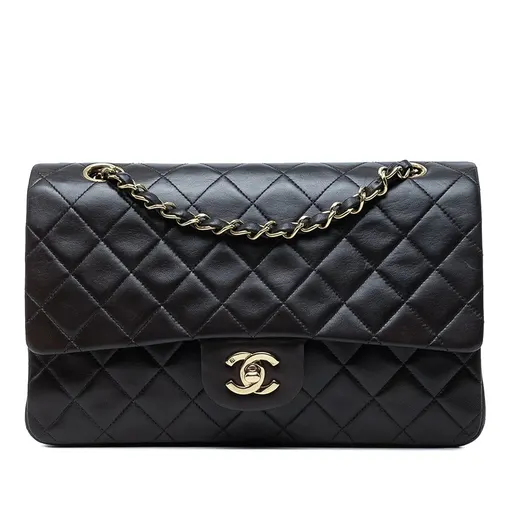
Chanel
Medium Classic Lambskin Double Flap
View piece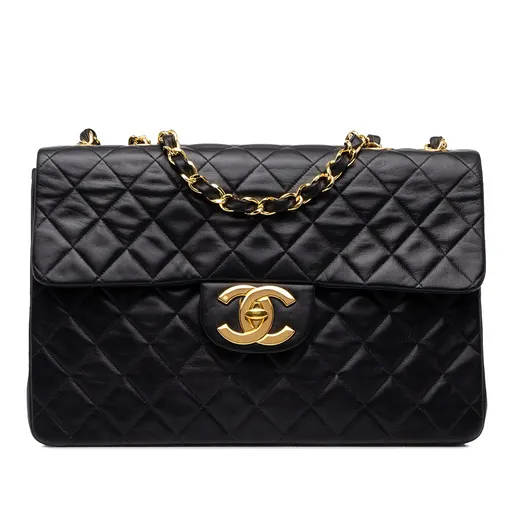
Chanel
Maxi XL Classic Lambskin Single Flap
View piece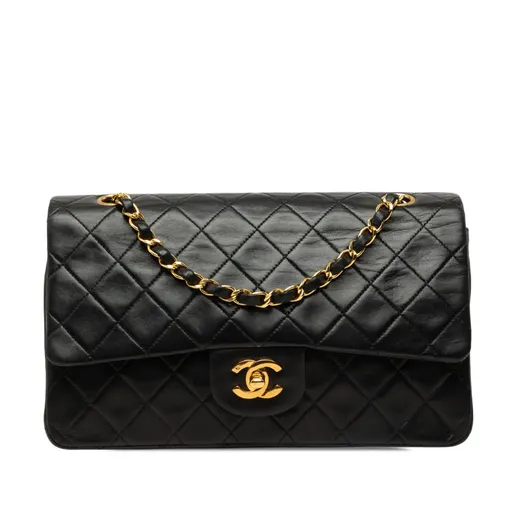
Chanel
Medium Classic Lambskin Double Flap
View piece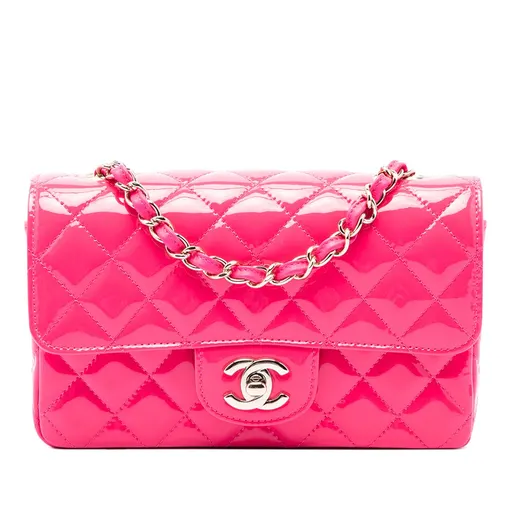
Chanel
Mini Rectangular Classic Patent Single Flap
View piece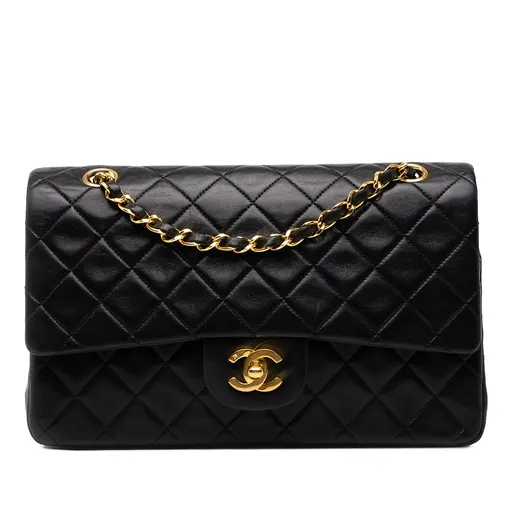
Chanel
Medium Classic Lambskin Double Flap
View piece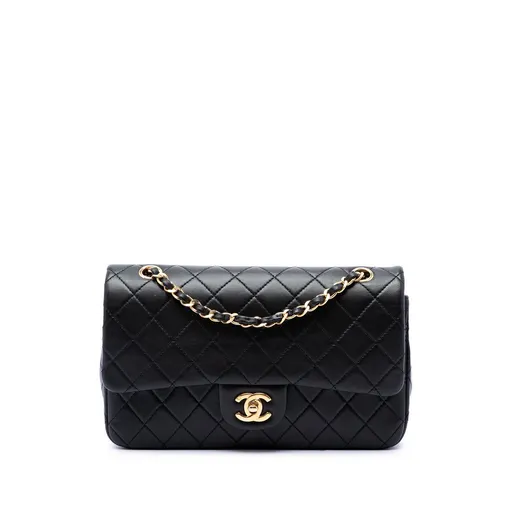
Chanel
Medium Classic Lambskin Double Flap
View piece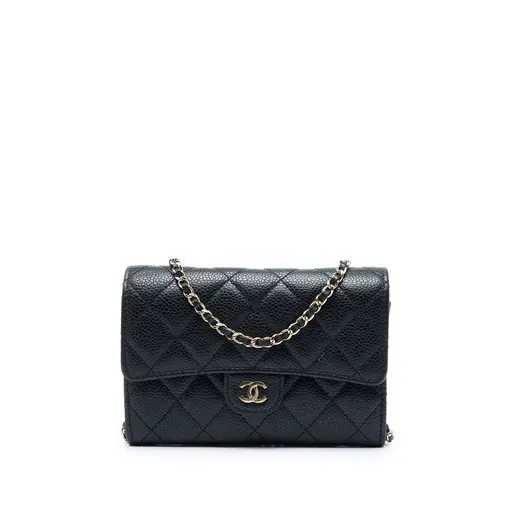
Chanel
Mini Classic Caviar Flap Wallet on Chain
View piece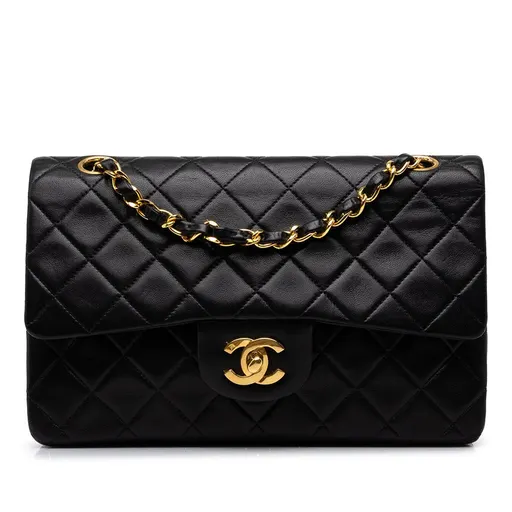
Chanel
Small Classic Lambskin Double Flap
View pieceAll dimensions above are the median measured width of the bags physically in our warehouse, not manufacturer specifications — which is why the Jumbo range runs 25–31 cm rather than a single tidy number.
Which one should you buy?
Reduced to decisions rather than data:
- First Chanel, and you want the one everyone recognises: Medium Classic Flap in caviar. It is the strongest value holder we measured at any size (60.8% for the Medium, 64.5% for caviar), and it is the bag the resale market will always want back.
- Budget around AED 11,000: Boy, Old Medium, caviar if you can find it. You get a full Chanel flap bag at half the Classic Flap's price with statistically the same value retention.
- You want the best retention per dirham spent: caviar, in either model. That single choice is worth roughly ten percentage points — more than picking the "right" bag.
- You want daily wear and you are hard on bags: Boy in caviar or calfskin. Structured, scratch-resistant, and its hardware is designed to look worn rather than damaged.
- You carry a lot: Jumbo Classic Flap. It costs the same as a Medium on the pre-owned market. Accept the four-point retention penalty as the price of the space.
- You want the purest Chanel design and do not care about resale: Reissue 2.55. At 45.2% of retail it is the cheapest way into a genuine Chanel icon that exists right now.
- You want lambskin because it is beautiful: buy it, and buy it in excellent condition. Just go in knowing the market discounts it about ten points, and treat that as the cost of the finish rather than a mistake.
Buying either one pre-owned in the UAE
Three things matter more than the model you choose.
1. Condition is the price, especially in lambskin
Corners, flap edges and the underside of the chain are where wear shows first. On a caviar bag light rubbing is cosmetic. On lambskin, corner wear is structural and will not improve. Look at the actual photographs of the actual item — not a stock image — and read the declared damages. Every listing we publish photographs the piece it is selling.
2. Serial and date code tell you the era, not the truth
Chanel used adhesive serial stickers with a matching authenticity card until April 2021, when it moved to embedded microchips readable only by Chanel's own staff. So a bag made after 2021 has no serial you or anyone else can look up, and the absence of one is not a red flag. For pre-2021 pieces, the serial series indicates a production year range, which is useful for dating and worthless as proof of authenticity — a good counterfeit copies a valid number. A serial decoder can tell you what a code means; it cannot issue a verdict on genuineness, because no decoder honestly can.
3. Authentication has to happen before the bag reaches you
Any eligible Chanel can be authenticated at checkout: it is checked in-house and, where the piece warrants it, through LegitGrails before it is dispatched. That is the part of the transaction you cannot do yourself from photographs, and it is the reason a pre-owned Chanel bought from a marketplace with no authentication step is not the same product at a lower price — it is a different product.
On price: UAE buyers pay a service fee on top of the listed price and 5% VAT applies at checkout. The figures throughout this article are buyer-facing and already include the service fee, so they are comparable to what you would see at checkout, before VAT.
What our stock says about demand
We hold 2.7 Classic Flaps for every Boy (249 against 91). That ratio is not a statement about which is better — it reflects thirty years of production against fifteen, and Chanel made the Classic Flap in far greater volume. But it does mean something practical for a shopper: if you want a specific Boy configuration — a particular size, leather and hardware combination — you will wait longer for it than you would for the equivalent Classic Flap. Boy stock turns over faster and returns less predictably.
Across the whole house we currently hold 4,639 authenticated Chanel pieces, 2,591 of them handbags — which is the practical reason we can publish leather-by-leather retention figures at all. You can browse the full range on our pre-owned Chanel page, or go straight to the two models compared here: Chanel Boy bags and Chanel Timeless Classic Flap bags.
Colour: half the market is black, and black is not the best value holder
Across all 340 bags in this comparison, colour distribution and value retention look like this:
| Colour | Share of stock | Median asking price | % of retail |
|---|---|---|---|
| Black | 51% (172) | AED 21,114 | 59.8% |
| Blue | 11% (39) | AED 19,706 | 57.9% |
| Red | 9% (32) | AED 18,416 | 58.6% |
| Pink | 7% (24) | AED 19,753 | 58.3% |
| White | 4% (13) | AED 21,346 | 63.9% |
| Beige | 2% (8) | AED 23,961 | 72.5% |
| Green | 3% (9) | AED 19,096 | 54.7% |
Black is exactly half our Chanel flap stock and its retention is unremarkable — 59.8%, essentially the average. The strongest retainers are beige (72.5%) and white (63.9%), the two scarcest colours in the table. That is the opposite of the usual advice to "buy black for resale", and the mechanism is straightforward: black is the safe default, so everyone buys it, so there is always another one available. Scarcity, not neutrality, is what supports an asking price.
Two honest limits on that: the beige and white samples are 8 and 13 bags, small enough that a couple of unusual listings move the median. And a pale bag is harder to keep clean, which is part of why fewer survive in resale condition — the scarcity is partly self-inflicted. Treat black as the liquid choice and beige or white as the higher-variance one.
Condition grade barely moves the price at this level
Of the 340 bags, 92% are graded Very Good and 8% Good. What is surprising is how little separates them on price: Very Good asks a median AED 20,408 at 58.7% of retail, Good asks AED 19,703 at 57.6%. Roughly one percentage point.
That is not a pricing error. It reflects that authenticated Chanel at this price point is filtered before it reaches the market — pieces in genuinely poor condition mostly do not get listed. So the practical guidance is: do not spend much effort hunting for a "Good condition bargain", because the discount for accepting visible wear is around 3–4%. Buy the better-condition bag; it costs almost nothing extra and it will resell more easily.
Who values a bag, and what durability actually means here
Three different jobs get confused with each other, and it is worth separating them before you buy or sell.
- Authentication answers "is this genuine?". It is a technical examination of stitching, hardware, leather grain, interior stamps and, on modern pieces, the embedded chip. We do it in-house and, where the piece warrants it, through LegitGrails. It is not a valuation.
- Valuation answers "what is it worth today?". It is a market question, driven by the model, size, leather, colour, hardware finish and condition — exactly the variables in this article. On a marketplace it is answered continuously by what comparable pieces are actually listed and sold at, which is why a live catalogue is a better guide than a static price list.
- Condition grading answers "how much life has it had?". It is a physical assessment: corner wear, flap-edge rubbing, chain plating loss, interior staining, odour, hardware tarnish.
On durability specifically, the useful distinction is between damage that ages gracefully and damage that does not. Caviar scuffing, chain plating patina and light interior marking all read as wear. Corner rub-through on lambskin, a stretched or cracked flap, and a broken turn-lock do not — they are structural and they are what the market discounts hardest. This is the same reason the caviar-versus-lambskin gap in this article is ten points wide: it is not that caviar is "better leather", it is that caviar's failure modes are cosmetic and lambskin's are permanent.
Frequently asked questions
Is the Chanel Boy bag a good investment compared to the Classic Flap?
On our live stock the two are statistically indistinguishable: the Boy asks a median 58.0% of its original retail, the Classic Flap 58.9%. The Boy is not a weaker investment — it is a cheaper one, with a median asking price of AED 11,028 against AED 21,675 for the Classic Flap.
Why is the Chanel Classic Flap twice the price of a Boy?
Because it retailed for roughly twice as much. The median recorded original retail is AED 38,566 for the Classic Flaps we hold and AED 20,562 for the Boys. The pre-owned market has applied a near-identical discount to both, so the retail gap carries through almost exactly.
Does caviar or lambskin hold value better?
Caviar, by around ten percentage points. Caviar Classic Flaps ask 64.5% of retail against 54.6% for lambskin, and the same pattern repeats on the Boy (60.9% versus 53.7%). Caviar is a pressed, grained leather that resists scratching; lambskin is smooth and marks easily, and the market prices that difference.
Which Chanel Classic Flap size holds its value best?
The Medium (25 cm), at 60.8% of retail, ahead of the Small at 58.6% and the Jumbo at 56.4%. All three sizes currently cost within AED 550 of each other on the pre-owned market, so size is close to free — pick the one you will carry.
What is the difference between the Chanel 2.55 and the Classic Flap?
The 2.55 is Coco Chanel's 1955 original: an all-metal chain and a plain rectangular Mademoiselle turn-lock with no logo. The Classic Flap is Karl Lagerfeld's 1983 redesign, which wove leather through the chain and replaced that lock with the interlocking CC clasp. They are different bags, and the market values them differently — the Reissue 2.55 asks just 45.2% of retail, the weakest of the three Chanel flaps we measured.
What is the difference between the Old Medium and New Medium Boy?
Width. The Old Medium is 25 cm across, the New Medium roughly 28 cm and visibly more rectangular. The Old Medium is the original proportion, is the size we stock most (34 of 91 Boys), and holds more of its value — 57.9% against 53.5% for the New Medium.
How much does a pre-owned Chanel Boy bag cost in Dubai?
Across the 91 Boy flap bags we currently hold, prices run from AED 7,114 to AED 23,948 with a median of AED 11,028. Small Boys sit around AED 9,974 and Old Mediums around AED 11,381. These are buyer-facing prices including the service fee, before VAT.
How much does a pre-owned Chanel Classic Flap cost in Dubai?
From AED 9,571 to AED 36,264 across the 249 in stock, with a median of AED 21,675. Caviar examples run higher at a median AED 25,333; lambskin sits at AED 20,878.
Does a Chanel bag without a serial number sticker mean it is fake?
No. Chanel stopped using adhesive serial stickers and authenticity cards in April 2021 and moved to embedded microchips that only Chanel staff can read. A post-2021 bag legitimately has no readable serial. For pre-2021 pieces a serial dates the bag but does not prove it genuine, since counterfeits copy valid numbers.
Which is more practical for everyday use, the Boy or the Classic Flap?
The Boy, if you are hard on bags — it is rigid, holds its shape when empty, and its hardware is finished to look worn rather than damaged. The Classic Flap carries more, thanks to its double compartment and rear pocket, and its adjustable chain converts from long to doubled. The Boy dresses down better; the Classic Flap dresses up better.
Are all these bags authenticated?
Yes. Authentication is available at checkout: the piece is checked in-house before dispatch, and through LegitGrails where the item warrants it. Shipping is via Aramex within the UAE and GCC and DHL internationally.
Is now a good time to buy a pre-owned Chanel flap bag?
The measurable fact is that both models currently ask a median 58–59% of their original retail. Whether that is attractive depends on the alternative you are comparing it to; what it does mean is that the pre-owned discount on a Chanel flap is currently around 41% of retail, and it is deeper on lambskin than on caviar.