
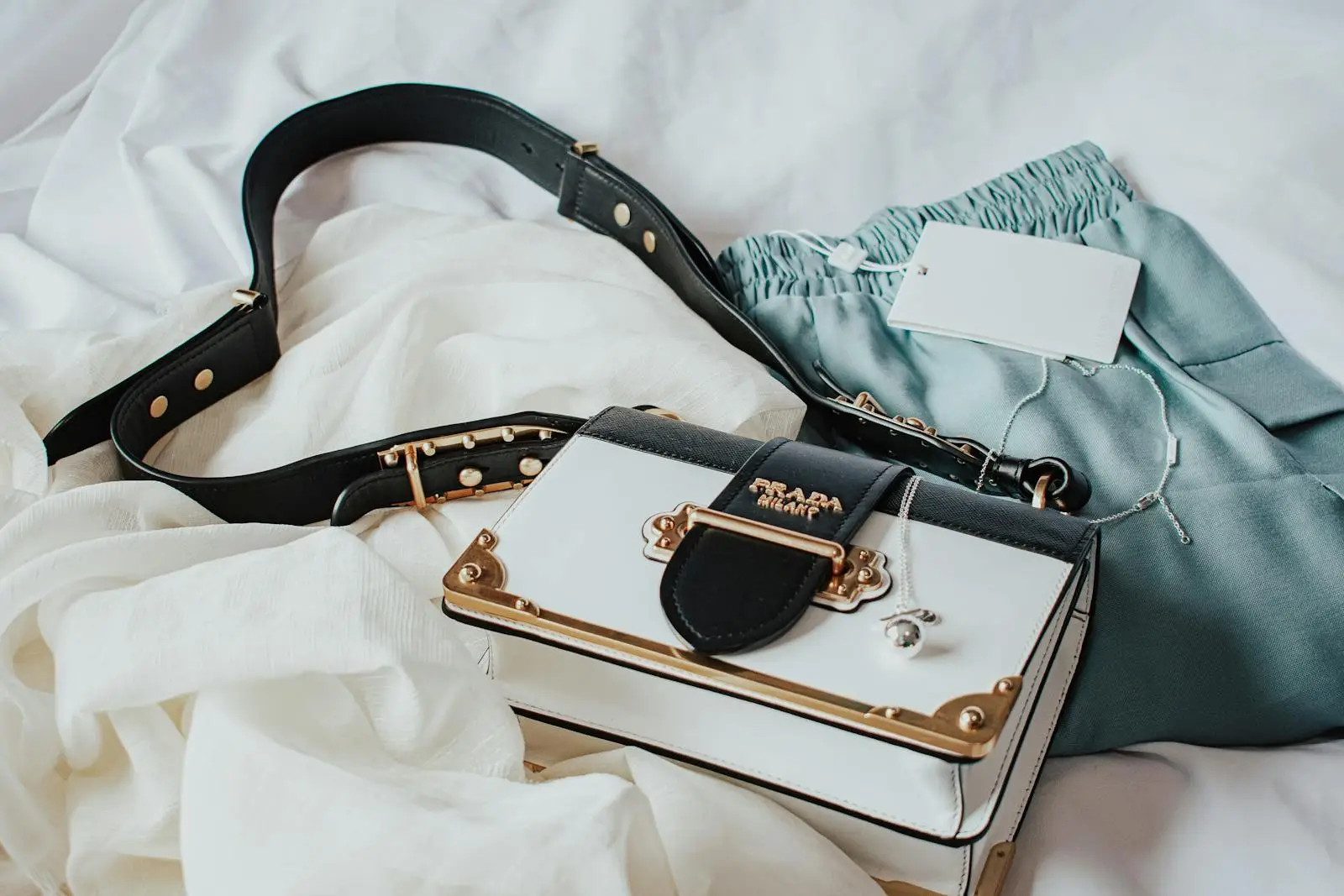
Prada's appeal lies in its understated intellectual elegance — and that same subtlety makes it a target for sophisticated counterfeiters. From the iconic Saffiano leather tote to the nylon backpack and the Galleria bag, this guide covers the authentication markers that separate the genuine article from the replica.
The Logo: Prada's Most Scrutinised Detail
The Prada logo — "PRADA" in capital letters with the House of Savoy crest above it — is applied in several ways: embossed on leather, engraved on hardware, woven into lining fabric, or applied as an enamel plaque. In every application it must be precise.
On the metal logo plaque found on many Prada bags, the letters should be evenly spaced, deeply engraved, and filled with a clean enamel. The crest above the lettering — a rope border with a crown and cross — should be crisp with no fuzzy edges. On fakes this crest is simplified, lacks detail, or has irregular rope borders.
The font matters too. Prada uses a specific serif typeface. Counterfeits often use a slightly wider or narrower font that looks wrong to a trained eye.
Saffiano Leather: The Definitive Texture
Saffiano leather — one of Prada's most iconic materials — is calfskin treated with a wax finish and stamped with a distinctive cross-hatch pattern. The result is a rigid, scratch-resistant surface with a subtle sheen.
Authentic Saffiano has a uniform cross-hatch pattern that covers the entire surface consistently, including around seams and at corners. The texture is raised and firm to the touch. The waxy finish gives a slight stiffness to the leather panel.
Fake Saffiano is either too soft (meaning the wax treatment wasn't applied), too shiny (over-lacquered synthetic), or shows an inconsistent cross-hatch pattern that fades at corners. The pattern on authentic bags never distorts at the edges — it wraps cleanly.
Hardware and Engravings
Prada hardware is clean and minimalist. Zippers are typically YKK or Lampo branded, and the zipper pulls often carry the Prada logo. The zip action should be smooth and silent — no catching, scraping, or squeaking.
Turn-lock closures on the Galleria bag are heavy brass with a satisfying click. The mechanism should engage and release cleanly. On authentic bags the interior of the closure shows "PRADA" engraved on the back plate.
D-rings, feet, and studs are all solid metal with consistent plating. Check the bag feet: genuine Prada feet are round, heavy, and sit flush. Fake bag feet are often glued rather than riveted, and will wobble or detach.
Nylon and Re-Nylon Bags
Prada's nylon bags — made from the brand's signature Pocono nylon or the newer Re-Nylon recycled fabric — have a tightly woven texture with a consistent sheen. The fabric is dense and doesn't pull or stretch easily.
Authentic nylon has a specific weight and drape. It holds its shape without being stiff. Fake Prada nylon is typically lighter, has a different sheen (often too shiny or too matte), and the weave is looser.
On the exterior of nylon bags, check the triangular logo plaque. This should be a thick enamel-filled metal plate screwed into the fabric, not glued on. The screws are visible on the interior lining. Any plaque that moves or feels hollow is not authentic.
Interior: Lining and Serial Numbers
Prada bags are lined in nylon, fabric, or leather depending on the model and year. The lining should be cleanly finished with no raw edges. Interior pockets are precisely stitched with matching thread.
Inside, you'll find a white interior tag with the Prada logo and a serial number. Older bags (pre-2010) have a simple serial number without the logo. Newer bags may have a QR code alongside the serial number for digital authentication.
The tag itself should be firmly attached — not glued in, but stitched along at least one edge. A loose tag is suspicious. A printed-on tag (not a separate sewn piece) is a definite fake.
Authenticity Cards and Receipts
Prada does not issue authenticity cards. If a seller provides one, it was created by the counterfeiter. Prada does sometimes include care booklets and dust bags (in beige nylon with the Prada logo), but these can be replicated. Original receipts from authorised Prada retailers are the most reliable provenance documents.
The Galleria and Re-Edition: Model-Specific Checks
The Prada Galleria is one of the brand's most replicated styles. On an authentic Galleria, the Saffiano leather should have a fine, uniform cross-hatch texture that feels dry and slightly rigid to the touch — never smooth, waxy, or soft. The texture should be consistent across every panel of the bag, including the sides, bottom, and interior pocket flaps. Fakes often have a coarser or shinier cross-hatch that does not match the refined Prada texture.
The triangular Prada logo plaque on the Galleria is metal and attached with small screws visible from the interior. On an authentic bag, the plaque sits perfectly flat against the leather, centred between the handles, and the engraving is sharp with clean edges. The letter spacing in "PRADA" should be even, and "MILANO" should appear below in a smaller font. Fakes frequently have plaques that are slightly too large, too small, or positioned off-centre.
The Prada Re-Edition (particularly the 2005 and 2000 models) has become one of the most counterfeited bags in the UAE market. The authentic Re-Edition uses Prada's signature nylon, which has a distinctive matte texture with a slight sheen — it should feel substantial and structured, not thin or papery. The metal zipper pulls should be engraved with "PRADA" in a precise, sans-serif font, and the chain strap links should be uniformly shaped and weighty.
Prada Authentication Numbers Explained
Prada serial numbers are located on a small white fabric tag sewn into an interior seam, usually at the top of an inner pocket. The tag displays two rows of numbers: the first row is a four-digit style code, and the second row identifies the colour and material. The numbers should be printed in a clear, consistent black font on a cleanly cut white fabric tag with neat stitching.
Older Prada bags (pre-2010) may have a slightly different tag format, but the placement and fabric quality remain consistent. The tag should never be glued in — it is always sewn. If the tag is missing, check for a heat stamp on the interior leather, which some Prada models use instead of or alongside the fabric tag.
Importantly, Prada authenticity cards (the black card with a barcode) have been used inconsistently across different periods and regions. While a missing card does not mean a bag is fake, the card itself should never be the sole basis for authentication. Always verify through the serial tag, hardware, leather quality, and construction details.
Common Scam Tactics When Buying Pre-Owned Prada
The Prada Re-Edition's popularity has made it a prime target for counterfeiters, particularly in the UAE. The most common scam involves social media sellers offering Re-Edition bags at 1,500–2,500 AED — roughly half the typical pre-owned price for an authentic piece. These fakes often use convincing nylon but fail on the interior tag, zipper engraving, and chain strap quality.
Another common tactic involves sellers combining authentic Prada accessories (dust bags, boxes, authenticity cards) with counterfeit bags. Prada dust bags and boxes are also counterfeited, but they are easier to replicate than the bags themselves. Never authenticate a Prada bag based solely on its packaging — always inspect the bag's own construction details.
For pre-owned Prada bags in the UAE, be cautious of sellers who describe bags as "store returns" or "sample sale" items. Prada does not sell returns or samples through unofficial channels. Legitimate pre-owned Prada bags come from their original owners who purchased at retail and are reselling through trusted platforms or consignment.
Professional Authentication for Prada
Prada counterfeits range from obvious fakes to sophisticated replicas that require expert examination. For any pre-owned Prada purchase above 3,000 AED, professional authentication is a worthwhile investment.
At Libas Collective, every Prada bag undergoes thorough authentication before listing — including Saffiano texture analysis, hardware verification, serial tag inspection, and construction review. Items requiring additional scrutiny are referred to independent services like LegitGrails for a second opinion.
For private purchases, remote authentication costs 100–200 AED and requires photos of the serial tag, logo plaque, zipper pulls, interior lining, and stitching. Turnaround is typically 24–48 hours, making it a fast and affordable safeguard against counterfeit purchases.
Buy Pre-Owned Prada with Confidence in the UAE
At Libas Collective, every Prada bag is authenticated by our team before it reaches the shop floor. We verify the logo plaque, Saffiano texture, hardware quality, serial number format, and interior finish. Shop our pre-owned Prada collection or read more of our designer authentication guides.
Libas Collective
Shop Pre-Owned Prada Bags
Browse authenticated pre-owned Prada pieces — fairly priced and delivered across the UAE.
How much does Prada authentication cost in the UAE?
Remote authentication through services like LegitGrails or Entrupy costs 100–200 AED per item. Authenticated marketplaces such as Libas Collective include professional authentication at no extra cost when buying through their platform.
Which Prada bags are faked most often?
The Prada Re-Edition 2005 is currently the most counterfeited Prada bag, followed by the Galleria and the Cleo. The Re-Edition's nylon construction and accessible price point make it a high-volume target for counterfeiters across the UAE and globally.
Does Prada still use authenticity cards?
Prada has used black authenticity cards with barcodes inconsistently across different periods and regions. A missing card does not necessarily mean a bag is fake, and the presence of a card does not guarantee authenticity. Always authenticate Prada bags through the serial tag, logo plaque, hardware engravings, and construction quality rather than relying on accessories.
More Luxury Authentication Guides
Shopping for pre-owned luxury? Make sure you can spot the real thing across every major brand:
- How to Authenticate a Louis Vuitton Bag
- How to Authenticate a Chanel Bag
- How to Authenticate a Gucci Bag
- How to Authenticate a Hermès Bag
- How to Authenticate a Dior Bag
- How to Authenticate a Prada Bag
- How to Authenticate a Fendi Bag
- How to Authenticate a Balenciaga Bag
- How to Authenticate a Celine Bag
- How to Authenticate a Bottega Veneta Bag
- How to Authenticate a Goyard Bag
- How to Authenticate a Loewe Bag
- How to Authenticate a Saint Laurent (YSL) Bag
Frequently Asked Questions
What does the Prada logo plaque look like on a real bag?
The Prada logo plaque is solid metal, engraved cleanly with PRADA in all capitals followed by MILANO below. The font is precise with consistent letter spacing and deep engraving. Fake plaques are often lightweight with shallow or uneven engraving.
How do I identify authentic Saffiano leather on a Prada bag?
Genuine Prada Saffiano leather has a fine, consistent cross-hatch texture that feels rigid yet smooth. Created by a heat press and wax treatment, it is naturally scratch-resistant. Fakes often use embossed PU leather that is softer, shinier, and irregular in texture.
Where is the authenticity card on a Prada bag?
Prada bags come with a white authenticity card inside a small envelope, along with a numbered tag attached to the bag. The card has the Prada logo and a unique serial number matching the interior label. Missing, laminated, or poorly printed cards are red flags.
What should the Prada interior label say?
The interior label of a genuine Prada bag reads PRADA on the first line, MILANO on the second, followed by Made in Italy and a serial number. Misspellings, uneven stitching around the label, or incorrect layout indicate a fake.
How heavy should a real Prada bag feel?
Authentic Prada bags feel substantial due to high-quality hardware and genuine leather. The metal zippers, clasps, and rings are solid and smooth-operating. Lightweight hardware that feels hollow or plastic-like is a strong indicator of a counterfeit.